

![Who Are The Best Mobile Game Backend Providers? [Updated for 2026]](/images/blog/best-mobile-game-backend-providers-2026-featured.webp)

A comparison of the leading game backend-as-a-service providers for mobile, PC, console, and web games — covering Metaplay, Beamable, Azure PlayFab, Photon, and Heroic Labs, with details on features, pricing, and how to choose the right one.
A robust backend infrastructure is the engine that powers all top-grossing games. It enables engaging gameplay experiences, and handles essential functions such as user authentication, multiplayer capabilities, LiveOps, leaderboards, cloud storage, and much more. However, there are numerous game backend providers (also called backend-as-a-service) in the market for mobile, PC, console and web games. By the end of this article, you'll have an understanding of who they are, and how they differ from each other.
Should You Build or Buy Your Backend Tech?
Most of the companies you see in the top grossing gaming charts use bespoke backend technology that they've built in-house. This provides customization and total control of the backend tech stack, but it requires hiring a team of engineers - a time-intensive and costly process.
The vast majority of game developers, however, do not have the time, human resources, or money to invest in building in-house backend tech.
Instead, they use external backend providers, which offer "plug and play" solutions that make the process far more affordable and efficient. In turn, this lets them focus on creating exceptional gameplay experiences.
So which game backend providers are leading the way, whether you're building on mobile or PC, or web or console? (Pro-tip: to stay ahead of your players, you need to be building on all of them).
Leading PC, Mobile and Cross-Platform Game Backend Providers in 2026
1. Metaplay: The Live Service Game Backend
Metaplay Overview
Metaplay is the backend for live service games. It is a fully-programmable, server-authoritative game backend purpose-built to maximize player LTV, retention, and monetization — the metrics that define whether a live service game thrives or dies. Whether you have a title with an already large player base that needs better backend infrastructure, or a new game with a growing audience that demands a backend capable of scaling with you, Metaplay delivers.
Metaplay is trusted by the world's leading game studios, including Supercell, Trailmix, Metacore, Lessmore, and more. These studios rely on Metaplay to power their live service operations because it provides the complete toolkit needed to run a game as a long-term business:
Metaplay supports a wide range of games built on Unity, from casual titles to real-time multiplayer experiences. Games made with Metaplay can be published on any platform, whether you're building on mobile, PC, console, or web browser.
Metaplay Technology
What sets Metaplay apart from other backend providers is full source code access and total programmability. At the heart of Metaplay is shared game logic between the client and server — you write your core game logic once in C#, and Metaplay runs it seamlessly on both the client and the server, eliminating the need to double-implement features or deal with sync headaches. This architecture is server-authoritative and cheat-proof by default, giving developers peace-of-mind as they scale their player base.
Alternative providers offer a limited set of functionalities, which are good enough to get you on par with your competitors. However, when the time comes to innovate, to add custom game features that are not supported by the limited off-the-shelf functionalities, problems emerge. Developers need to do a major code refactor or migrate their game to a different backend provider. At best, this drags on for a few months. At worst, it's a disaster that eats years of development time.
Metaplay, by contrast, offers a tech upgrade path that ensures game innovation is never stifled by technological limitations. Because Metaplay ships as source code deployed into a game developer's own cloud, studios never have to worry about vendor lock-in or vendor risk — you own your infrastructure and your data.
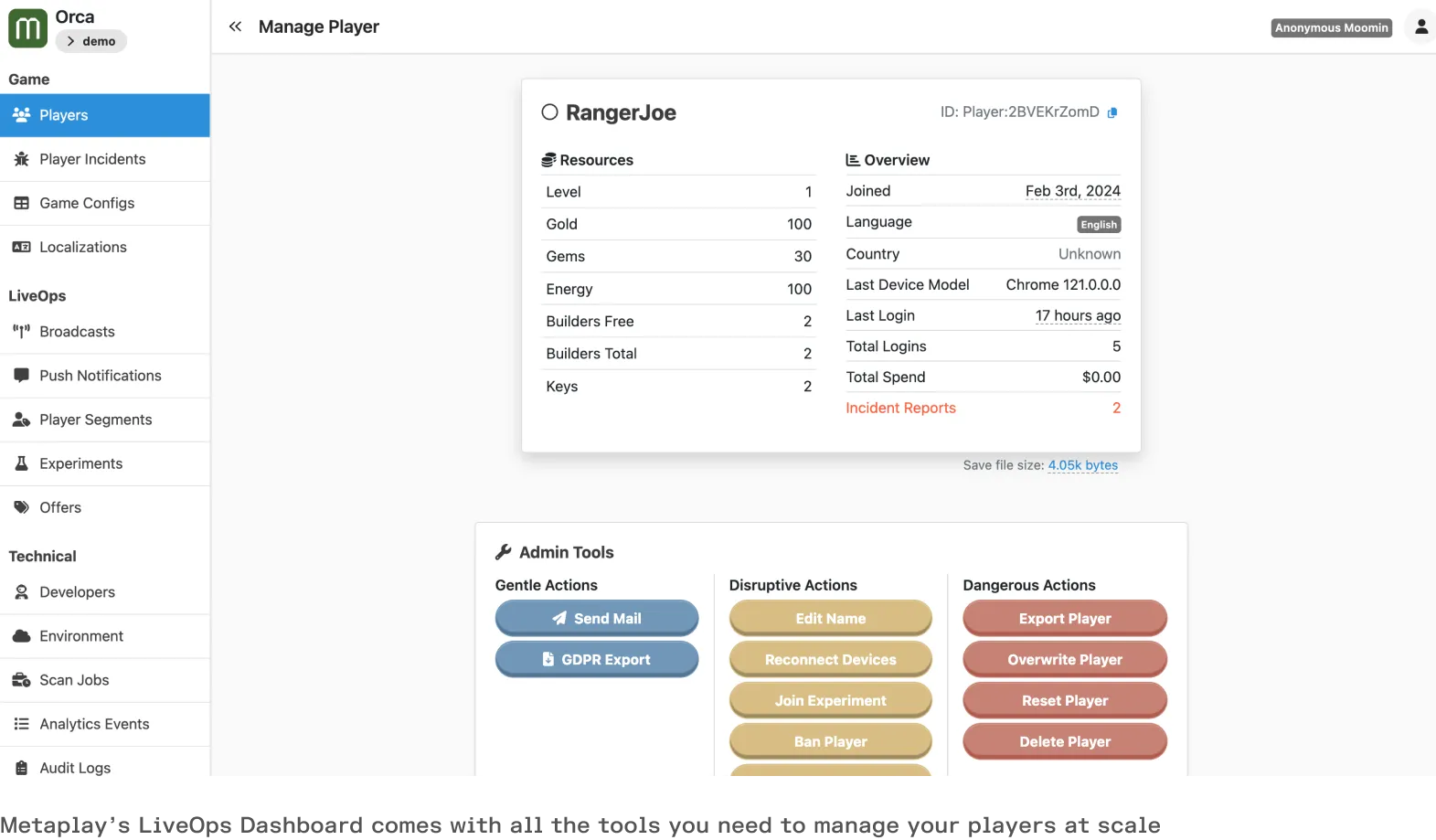
Metaplay LiveOps Dashboard
The Metaplay Unity SDK includes a pre-built but fully customisable LiveOps Dashboard featuring player support (inspect player state and behavior, apply changes safely), game operations (manage matchmakers, guilds, and game-specific features), and LiveOps tooling (A/B tests, segmentation, events, offers, configs, and localizations). This is the operational backbone that enables studios to continuously boost retention and monetization through data-driven LiveOps, keeping players engaged and spending over the long term.
Metaplay AI & Developer Experience
Metaplay is actively integrating AI into the game backend workflow. MetaplayGPT is an AI-powered tool that gives developers conversational access to the entire Metaplay SDK, source code, and technical documentation — letting them get production-ready answers about backend architecture in minutes rather than hours. Beyond documentation, Metaplay is exploring AI-driven features including intelligent game config suggestions, automated anomaly detection, and AI-assisted LiveOps that can identify player behaviour patterns and recommend interventions.
Developer experience is also a priority: Metaplay offers a one-command local server (no Docker or database installs required), first-class IDE support for running and debugging server code from Visual Studio or Rider, a CLI for project management and cloud deployments, and an embedded mock backend for fast offline iteration.
Learn more about Metaplay's game backend.
Metaplay Pricing
Metaplay's pricing is structured across five tiers to support studios from early prototyping to massive-scale live games:
- Free - Build and run your Metaplay game locally with full SDK access, at no cost. Includes integration links, documentation, example projects, and a dashboard demo.
- Starter (EUR 195/month) - For earliest prototyping of new games. Includes one mini cloud environment with online deployments, small-scale testing, and access to Metaplay's LiveOps Dashboard.
- Pre-launch (EUR 995/month) - For early development of new games. Includes two small environments with up to 100 DAU.
- Production (EUR 1,985/month) - For launching and scaling live games. Includes staging and production environments with unlimited DAU.
- Private Cloud (custom pricing) - For self-hosting games at massive scale with enterprise deployment options.
Studios can also choose from support packages ranging from free community Discord access to dedicated engineering support and 24/7 critical incident response. Visit the pricing page for full details.
2. Beamable
Beamable Overview
Beamable is a backend and LiveOps platform that has increasingly positioned itself at the intersection of Web2 and Web3 gaming. It provides a fully managed SaaS backend with features including accounts and social login, groups/guilds/teams, chat, friends, leaderboards, tournaments, live events, in-game mail, push notifications, analytics, segmentation, commerce/storefront, payments, inventory, and a relay server for multiplayer.
From a Web3 perspective, Beamable enables hybrid architectures where developers can use traditional backend systems for gameplay while leveraging blockchain for digital ownership, on-chain authentication, player wallets, trading, and tokenized rewards. In early 2025, Beamable introduced the Beamable Network, a DePIN (Decentralized Physical Infrastructure Network) for gaming that provides distributed compute, decentralized storage, and high-speed transaction capabilities on a Solana-based network.
Beamable offers both Unity and Unreal SDKs, and provides microservices that eliminate the need to build and operate a separate game server. The platform reports powering 95+ live games and handling 10B+ API calls per month.
Beamable Pricing
Beamable employs a combination of subscription and usage-based pricing. Subscription prices cover development costs, while usage pricing (based on API calls, developer seats, and microservice instances) covers scaling:
- Free tier - Free to develop up to 100K API calls.
- Paid tiers - Flexible subscription tiers for studios of all sizes, starting from around $95/month for indie developers through to enterprise plans. Additional monthly API usage is billed at $10 per 1M API calls.
- Enterprise - Reserved pricing, API call rollover, and additional discounts for games making more than 200M API calls per month.
Beamable does not charge separately for storage, bandwidth, cloud code, LiveOps tools, or DevOps tools. Pre-payment discounts are available for 3, 6, and 12-month commitments.
3. Azure PlayFab
PlayFab Overview
Azure PlayFab, owned by Microsoft (and formerly known only as 'PlayFab'), provides a solid set of building blocks to launch a fully functional game and is one of the longest-running backend solutions, having launched in 2014. It gives developers game services, data analytics, and live operations tools to launch faster, extend a game's lifecycle, and reduce costs.
On a high level, PlayFab's offering can be divided into three pieces: multiplayer tools, LiveOps tools, and analytics.
PlayFab's tools for multiplayer games include Party (low-latency chat and data communication), cross-network identity and data, multiplayer servers for dynamically scaling game server hosting in Azure, leaderboards and statistics, and matchmaking and lobby systems with real-time notifications.
PlayFab's LiveOps tools include Economy v2 (a massively scalable service handling large inventories and catalogs), player communication, automation to set up custom operations and react to events in real-time, content management (like remote updates to game assets), and experiments (like running A/B tests on player segments).
PlayFab's analytics enables real-time data collection and analysis to understand game performance and player behavior. In terms of data, PlayFab also ensures GDPR and COPPA compliance. Note that PlayFab Insights Management was deprecated in late 2023, with Microsoft now recommending Azure Data Explorer (ADX) Connections for analytics.
PlayFab Pricing
PlayFab's pricing uses a consumption-based model with several entry points:
- Free (Development mode) - Up to 100,000 users, allowing developers to connect a title currently in development without cost.
- Pay-as-you-go - A no-commitment plan billed based on actual usage (active players, storage, bandwidth), providing a more accessible entry point for smaller developers.
- Standard - Starting at $99/month with additional usage-based charges.
- Premium/Enterprise - Custom plans for major studios with dedicated support and advanced SLAs.
Multiplayer Servers are billed separately on a consumption basis.
4. Photon
Photon Overview
Photon's inclusion on this list could be seen as slightly contentious as strictly speaking, it's not exactly a backend (or at least not in the same sense as the other vendors on this list). More so, Photon is a multiplayer engine that is particularly valuable for developers aiming to create highly scalable and real-time multiplayer experiences.
Photon Engine's product suite includes several specialized tools: Photon Fusion delivers high-performance state synchronization with various network topologies; Photon Quantum is a full deterministic multiplayer engine with prediction and rollback on physics and inputs, eliminating the need for netcode while ensuring zero-lag gameplay with strong cheat protection; Photon PUN (Photon Unity Networking) provides a Unity-focused networking solution; and Photon Chat and Photon Voice handle in-game text and voice communication respectively.
One of the standout features of Photon Engine is its low-latency and reliable networking capabilities across a global footprint of bare-metal data centers on six continents. This makes it an ideal choice for fast-paced multiplayer games, such as first-person shooters or sports simulations.
Photon also offers extensive matchmaking and lobby management functionality, allowing developers to create custom matchmaking algorithms and efficiently connect players. This feature is invaluable for games that rely on fair and balanced matchmaking, enhancing the overall player experience.
Note that Photon is not a complete backend provider - it focuses on multiplayer game networking infrastructure. Some developers, for instance, use Photon in tandem with other backend tools like Metaplay to cover all of their mobile game's backend needs including LiveOps, economy, and player management.
Photon Pricing
Pricing for Photon is tiered according to Concurrently Connected Users (CCU), with approximately 3 GB of traffic bundled per CCU:
- Free - Up to 100 CCU (approximately 40,000 MAU) at no cost for Fusion and Quantum.
- 200 CCU Plus - $95 one-time for 12 months.
- 500 CCU Growth - $125/month with 1.5 TB bundled traffic.
- 1,000 CCU - Approximately $185/month with bundled traffic.
- 2,000+ CCU (Premium Cloud) - $0.50 per CCU with DDoS protection, SLA response times, and ops-specialist support.
Photon also offers a 48-hour CCU burst window for viral spikes, and annual commitment discounts (two months free).
5. Heroic Labs
Heroic Labs Overview
Heroic Labs offers the Heroic Game Stack, a composable product suite featuring an open-source game server, a LiveOps platform, a game development toolkit, and managed cloud services.
Nakama, Heroic Labs' flagship tool, is a scalable and flexible open-source backend server for multiplayer games. It provides essential features such as user authentication, real-time multiplayer functionality, social features, leaderboards, and server-side scripting. Nakama is particularly valuable for developers looking to create large-scale multiplayer experiences across different platforms, as it offers high-performance networking and seamless synchronization. Nakama continues to receive regular updates, with the latest releases adding improvements to console user management, faster party cleanup, and enhanced runtime event hooks.
Satori is Heroic Labs' LiveOps platform, providing tools for live events, messaging, feature flags, A/B experiments, and real-time data streaming. It is particularly useful for building live, interactive, and immersive experiences such as massively multiplayer online games (MMOs), live competitions, or other collaborative experiences. Recent updates have introduced a redesigned feature flags experience, new messaging capabilities, and precision tools for running cleaner experiments.
Hiro is Heroic Labs' game development kit (GDK), a client-server library built on the Nakama game server with built-in game economy, social, and LiveOps features pre-made to flexibly integrate into your game. Recent updates have expanded Unreal Engine support (Online Subsystem for Identity, Achievements, and Leaderboards) and introduced a major upgrade to the Teams system, where everything available to individual players - Achievements, Inventory, Economy, Stats, and more - is now available at the team level.
Heroic Cloud lets developers deploy dedicated Nakama and Satori clusters on managed infrastructure (available on GCP or AWS in North America, Europe, and Asia), with SOC 2 Type II compliance, automated scale-out, and scheduled database backups.
Heroic Labs Pricing
Heroic Labs offers a flexible pricing model based on cloud tier and support needs. Nakama's open-source server can be self-hosted at no cost, making it accessible to indie developers. For managed hosting via Heroic Cloud, pricing scales from development tiers (with burstable CPU and micro databases) to production tiers with dedicated hardware resources, and Private Cloud options that include all server licenses and premium support. Specific pricing is available on request through their website.
How to Choose the Right Backend Provider for Your Game
When it comes to backend infrastructure for mobile, PC, console, and web and browser games, partnering with an external provider rather than building your own technology offers numerous benefits. Aside from saving significant time and money, developers are able to maintain focus on the number one priority: building an engaging gameplay experience that keeps their players coming back for more.
Choosing the right backend provider is a big decision, and requires a lot of research. Ideally, the backend service you go with from day one will remain your provider over the long-run, as the cost of switching later is higher, and will continue to rise as a game matures.
This article was designed to serve as an overview of the leading mobile game backend providers, but it is far from definitive. Use this as a starting point for conducting deeper research, and remember that your game is likely to evolve in ways you haven't thought of yet - so ensure your backend provider gives you all the functionalities, scalability, and reliability to support your future tech needs.
FAQ
What are the main advantages of using a game backend-as-a-service over building in-house?
A BaaS provider gives you years of production battle-testing from day one – authentication, leaderboards, multiplayer, and LiveOps tooling that would take an internal team two to four years to build and maintain. The studio's engineering capacity goes into the game itself rather than the platform underneath it, which compounds into a meaningful competitive advantage over time.
Are these backend providers suitable for both indie developers and larger studios?
All of the backend providers listed here offer some form of free or low-cost entry point, making their services accessible to developers with different budgets. Metaplay, for example, offers a Free plan for local development and a Starter plan starting at EUR 195/month, while also providing enterprise-grade Production and Private Cloud tiers for studios at scale. Similarly, PlayFab, Beamable, Photon, and Heroic Labs (via self-hosted Nakama) all offer free tiers for getting started.
Can I migrate an existing game to a different backend provider?
Migrating an existing game to a different backend provider is possible but requires development and integration work - which can cause a headache when you're trying to focus on efficiently running your game. The extent depends on the complexity of your game and the compatibility between providers. This is why choosing the right backend provider from the start is so important - just ensure your backend provider offers a tech upgrade path that has all your potential long-term needs covered.
Can I customize the features provided by backend providers to suit my game's unique requirements?
The only backend provider that gives developers total flexibility is Metaplay because it ships as source code deployed into your own cloud, and is fully extensible. Most backend providers offer pre-built features with some degree of customization, but the extent is usually limited. Consider factors such as your game's genre, scalability needs, pricing structure, and the level of support provided when making your choice.

![Player Expectations in 2025: An Overview of Key Player Trends in Games [Updated for 2026]](/images/blog/player-expectations-in-games-in-2025-featured.webp)