

![AI in Game Development: How Studios Are Using AI to Build and Operate Games [Updated for 2026]](/images/blog/ai-in-game-development-featured.webp)

From generative code and AI-driven content creation to intelligent NPCs and LiveOps optimization, game studios are using AI across the entire development pipeline. Here's how AI is reshaping game development.
Generative AI Tools for Game Development
Generative AI is transforming how games are made. Here's a snapshot of how studios are using it across the development pipeline:
- Code generation — Tools like ChatGPT and GitHub Copilot generate code examples, suggest fixes, and help debug directly within your IDE
- 2D and 3D asset creation — Platforms like Layer.AI enable rapid asset generation
- World building — Tools like Atlas can populate open world maps with generated content
- Marketing — Services like Reforged Labs generate high-performing video ads
- Real-time game generation — Experimental platforms like Oasis generate playable games in real time
There's no substitute for human creativity and expertise, and we'd always recommend checking the datasets your AI tools are trained on. However, the impact generative AI is making across multiple areas of game development is unmissable.
User Generated Content and AI in Games
AI is a powerful tool for developers, but it could be even more transformative in the hands of players.
Parisian startup Kinetix enables players to create emotes from their own videos using generative AI, unleashing new avenues for self-expression and monetization.
Bitmagic, a Supercell-backed studio built on Metaplay, lets players create 3D worlds and quests in 30 seconds using text prompts — a much simpler creation process than platforms like Roblox. Already in early access on Steam, Bitmagic took home the award for "Best Generative AI & Agents" at Game Changers 2025.
How Bitmagic Uses Metaplay to Power AI-Driven UGC
To support player world-building at scale, Bitmagic built its tech on Metaplay. As a multiplayer platform, Bitmagic enables players to share AI-generated worlds and experiences with fellow players.
Bitmagic chose Metaplay for player management, authentication, and curation of recommended worlds. Metaplay allowed the team to move quickly and experiment with gameplay instead of spending time building backend infrastructure.
As generative AI is put into players' hands, controlling the cost of player prompting is important. Metaplay's backend enables cooldowns that limit excessive prompts within a short timeframe.
Bitmagic is also one of the first studios using Metaplay's Steam support, which enabled them to launch their Playtest on Steam with a mobile version planned for iOS and Android. (Read more about launching a successful cross-platform release here.)
AI Agents and Intelligent NPCs
AI enables not only the creation of characters, but also the logic that makes them interactive and responsive. Companies like Charisma.ai enable truly interactive conversations with AI characters that can take gameplay in entirely new directions.
This technology is also enabling the emergence of the "AI concierge" — a character that becomes the player's guide to the game and an interface with the in-game store. Think of them as a friendly shopkeeper who's exceedingly good at upselling customers. Early examples are already visible in Fortnite, where players interact with NPCs to receive in-game items.
AI for Optimizing Live Games-as-a-Service
Maintaining a live service title requires constant LiveOps monitoring. Machine learning systems from the likes of Golden Whale ingest both historic and live data to tailor LiveOps strategies with features personalized to individual players.
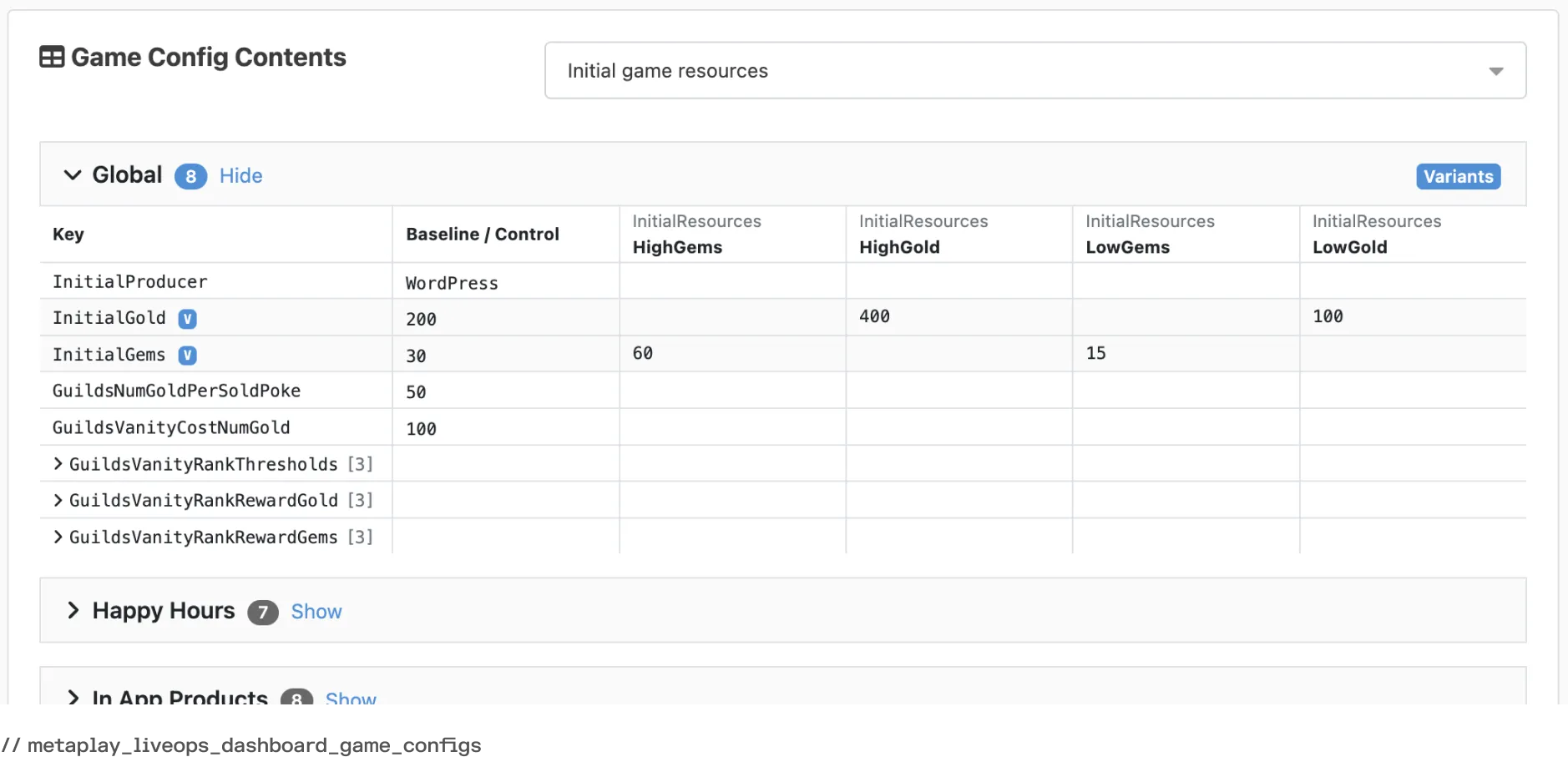
There's a myriad of items that require optimizing in a live game: IAP pricing, game balancing, and level difficulty. These are often stored as game configs managed through a game backend.
In Metaplay's case, game configs are easily editable through spreadsheets, which can be hooked up to the LiveOps Dashboard and used to manage an entire game's economy remotely — complete with diffing tools and version control. These are critical tools for managing a live game at scale.
AI-Powered Game Operating Systems
Finnish startup Cosmic Lounge has created a proprietary AI-powered "Puzzle Engine" for mobile developers which supports rapid content creation. By giving studios a no-code toolset, Puzzle Engine enables them to:
- Prototype and market-test concepts more quickly, and build minigames for ad creatives
- Constantly update games with new content and features, including fresh levels
- Release events and updatable features more quickly, all the way down to game mechanics
In a similar vein, Metaplay is designed to support developers from their first line of code through to LiveOps and player support. Metaplay ships as source code and is fully extensible, making it possible for studios to build their own AI integrations into it.
Beyond, the studio founded by Huuuge Games founder Anton Gauffin, is bridging the gap between entertainment and AI. Their BeyondOS is a platform powered by different AI diffusion models — and like Bitmagic, Beyond has selected Metaplay as its backend of choice.
What's Next for AI in Game Development?
AI's ability to rapidly generate content and logic is speeding up how updates and entirely new games are created. But a constant content flow for LiveOps is redundant if extensive downtime is needed for each update.
Part of the power of AI lies in its ability to integrate into existing tech stacks, so AI-generated content can be pushed over-the-air through backends like Metaplay. It's exactly the approach Metaplay customers Beyond and Bitmagic are taking — using AI to create new experiences underpinned by foundational backend tech.
AI is becoming an increasingly prominent part of the games industry as a tool for both developers and players. With its rapid advancement, scalable and dependable tech is essential. The question for studios is: is your foundational tech prepared?
FAQ
How can AI be integrated with a live service game backend?
AI-generated content can be delivered to players over-the-air through game config systems. With Metaplay, game configs are managed via spreadsheets and pushed through the LiveOps Dashboard — no client update required. This makes it straightforward to integrate AI content pipelines into your live game.
What are the risks of using AI in game development?
Key considerations include dataset provenance (what your AI tools are trained on), content moderation for player-facing AI, cost management for real-time inference, and ensuring AI-generated content meets your quality bar. A robust backend with rate limiting and content validation helps mitigate these risks.
Can Metaplay support AI-powered game features?
Yes. Metaplay is fully extensible and ships as source code, so studios can build custom AI integrations directly into their game backend. Customers like Bitmagic and Beyond are already using Metaplay to power AI-driven experiences.
How do studios manage the cost of player-facing AI features?
Backend systems like Metaplay can enforce cooldowns, rate limits, and usage caps on AI prompting to control costs. This ensures AI features remain sustainable at scale without degrading the player experience.

![Player Expectations in 2025: An Overview of Key Player Trends in Games [Updated for 2026]](/images/blog/player-expectations-in-games-in-2025-featured.webp)