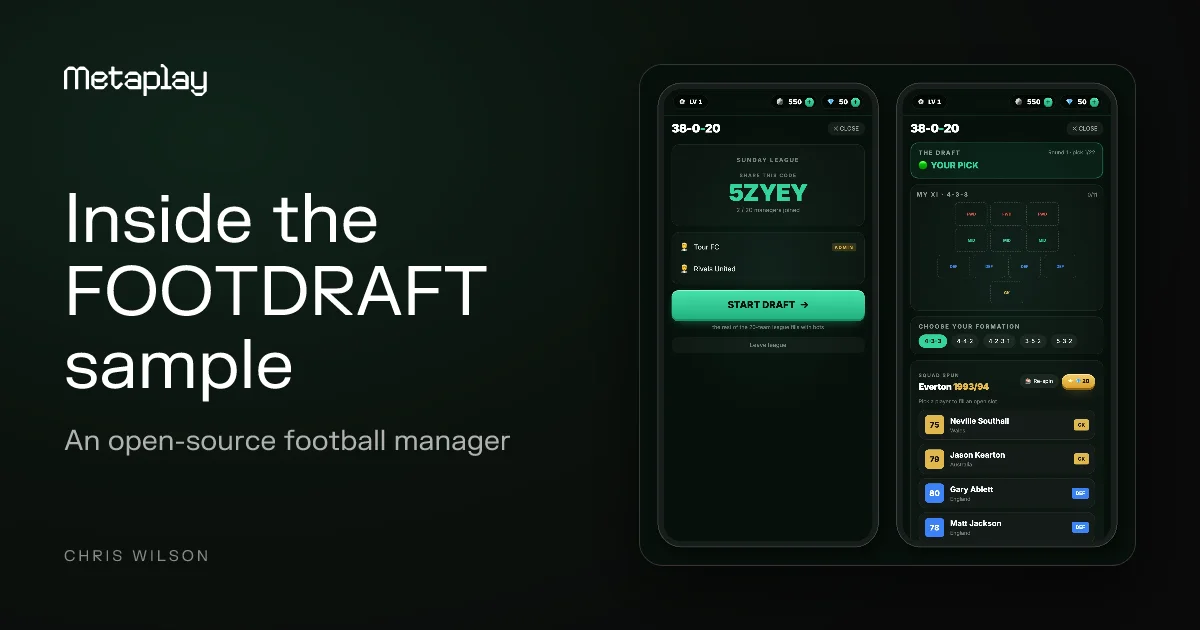

Five commits, a 20-team league and a transfer market: the FOOTDRAFT build read from its repo, and what a football manager asks of a live service backend.
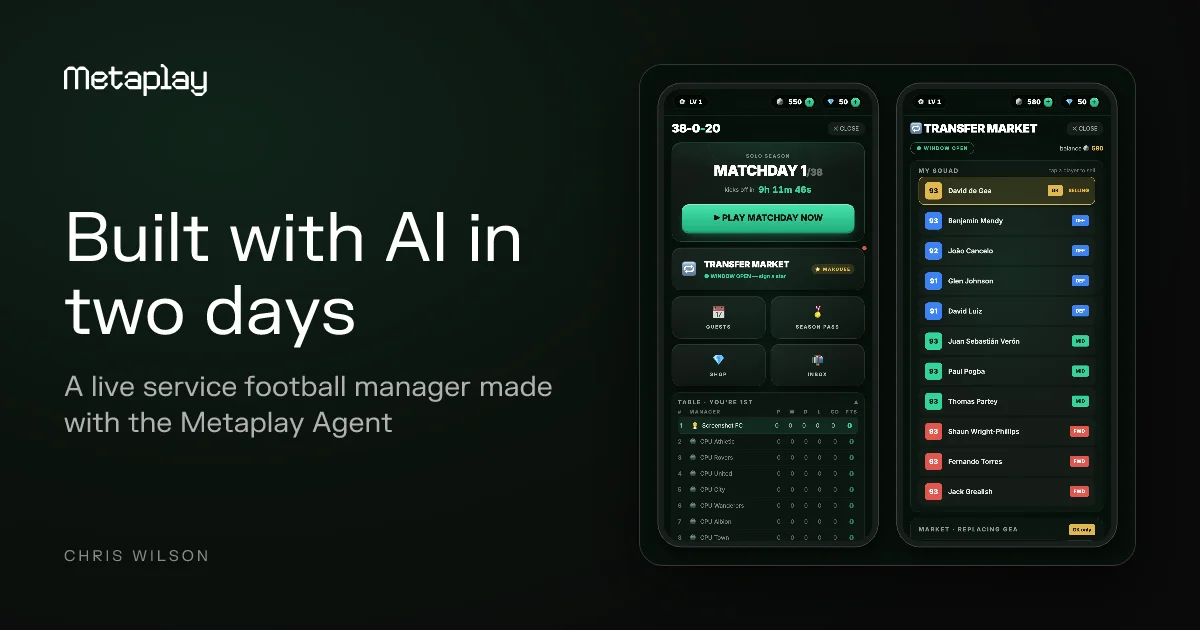
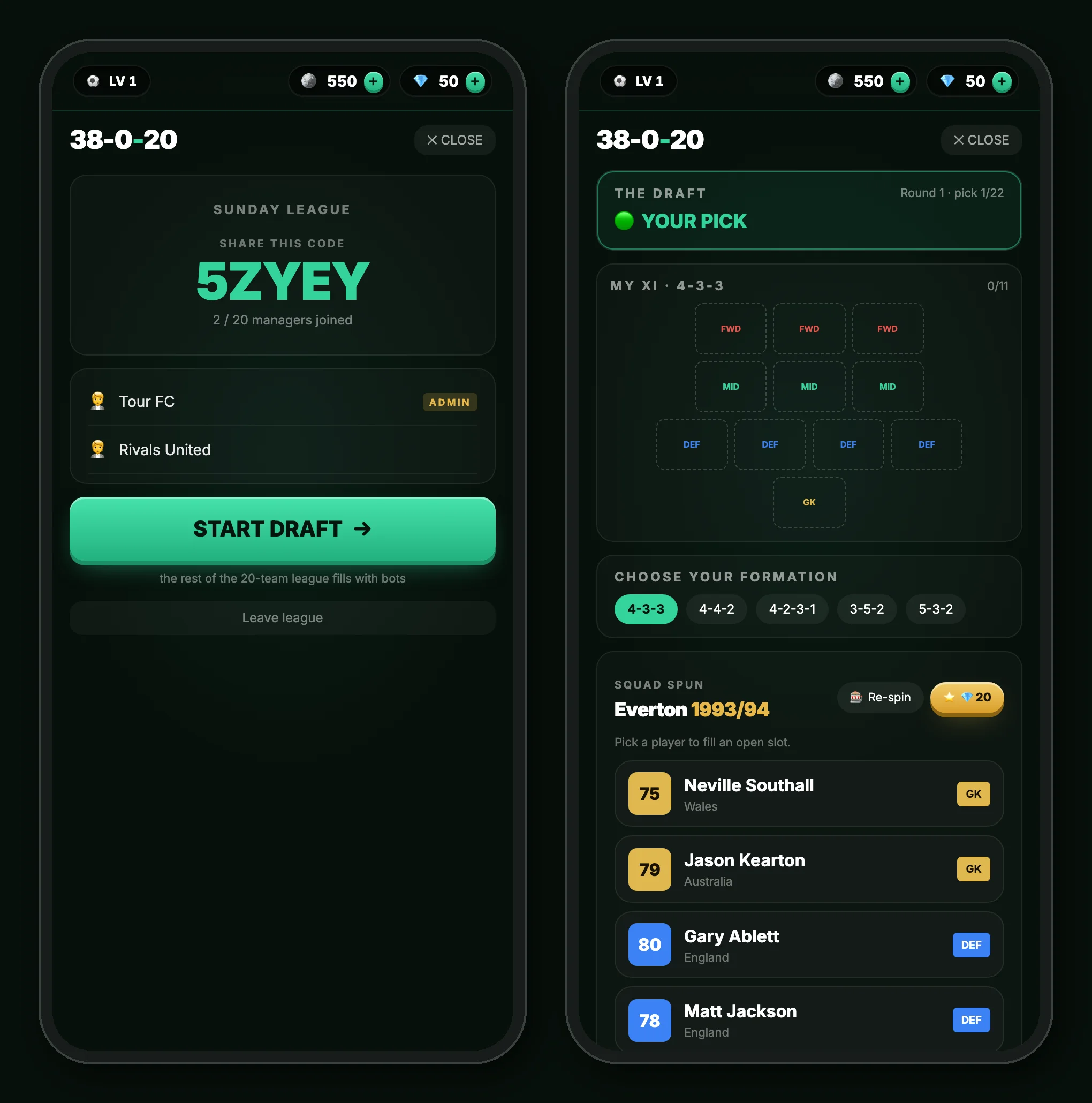
We built FOOTDRAFT to find out how far the Metaplay Agent could take a live service game with a person describing features and the Agent writing the code. The result is a multiplayer football manager with a 20-team, 38-matchday season league, a transfer market, a wallet, daily and season quests, a season pass, a ranked ladder and LiveOps events, all running in a web browser. It took two days of prompting plus two overnight runs.
The prompting was done by a member of our marketing team, fitted around a day job. That was the test: the Agent carries the Metaplay SDK's conventions, so the person driving it does not need to. You can play FOOTDRAFT live and read every line at metaplay-shared/footdraft. This post reads the build back from the repository, commit by commit.
What a football manager game needs from a live service backend
We build sample games across different genres, because each genre leans on a different part of the backend. A football manager asks a lot of it:
- Twenty managers share one league, so the season lives on the server in a persisted
LeagueActorrather than on anyone's device. - Matchdays are simulated on a schedule, one per day, and every manager sees the same result.
- Managers trade players with each other, so every transfer is validated and settled by the server, with escrow for player-to-player deals.
- Designers rebalance legends, formations and league rules from a Google Sheet without a deploy.
The same parts carry over to other genres: shared persistent state, scheduled server-side simulation, a player economy the client cannot cheat, and config that changes while the game is live.
How to build a live service game with AI in two days
The loop was short: describe a feature, review what the Agent produced, correct it, move on. The prompts were written between meetings and before bed, and the first write-up covers those two days in detail. The two overnight runs went unattended. The first loaded 23,913 real player-seasons from 1992 to 2024 into a Google Sheet that designers can edit. The second fixed the UI and added match screens that reveal goals minute by minute.
What an AI coding agent needs to build a live service game
The repo gives the Agent its bearings. A CLAUDE.md file describes the project, and four Metaplay skills sit under .claude/skills/: metaplay-develop, metaplay-devops, metaplay-docs and metaplay-troubleshoot. With those in place the Agent works in the SDK's own patterns, so the code it writes uses the same server-authoritative actors, shared client-server logic and LiveOps configs a Metaplay engineer would reach for.
The live service game build log, commit by commit
The whole history is five commits.
On 2026-06-11 the initial public release landed as one commit, 77fd7f50, adding 63,408 lines. It already held the full game: the spin draft, the 20-team double round-robin season with daily simulated matchdays, the wallet-driven transfer market, quests, the season pass, the ranked ladder and LiveOps events.
On 2026-06-12, commit ef28fd1a added a "Made with Metaplay Agent" credit to the footer of every screen.
On 2026-06-24 came the World Cup commit, 039a80bf, the largest since launch at 26,778 lines added across 65 files. Two small fixes followed the same day, 94725bc7 and 4d13f021, for the World Cup draft's player lookup and its era labels. Every commit after the initial release carries a Claude Opus 4.8 co-author credit.
Adding features to a live service game with an AI coding agent
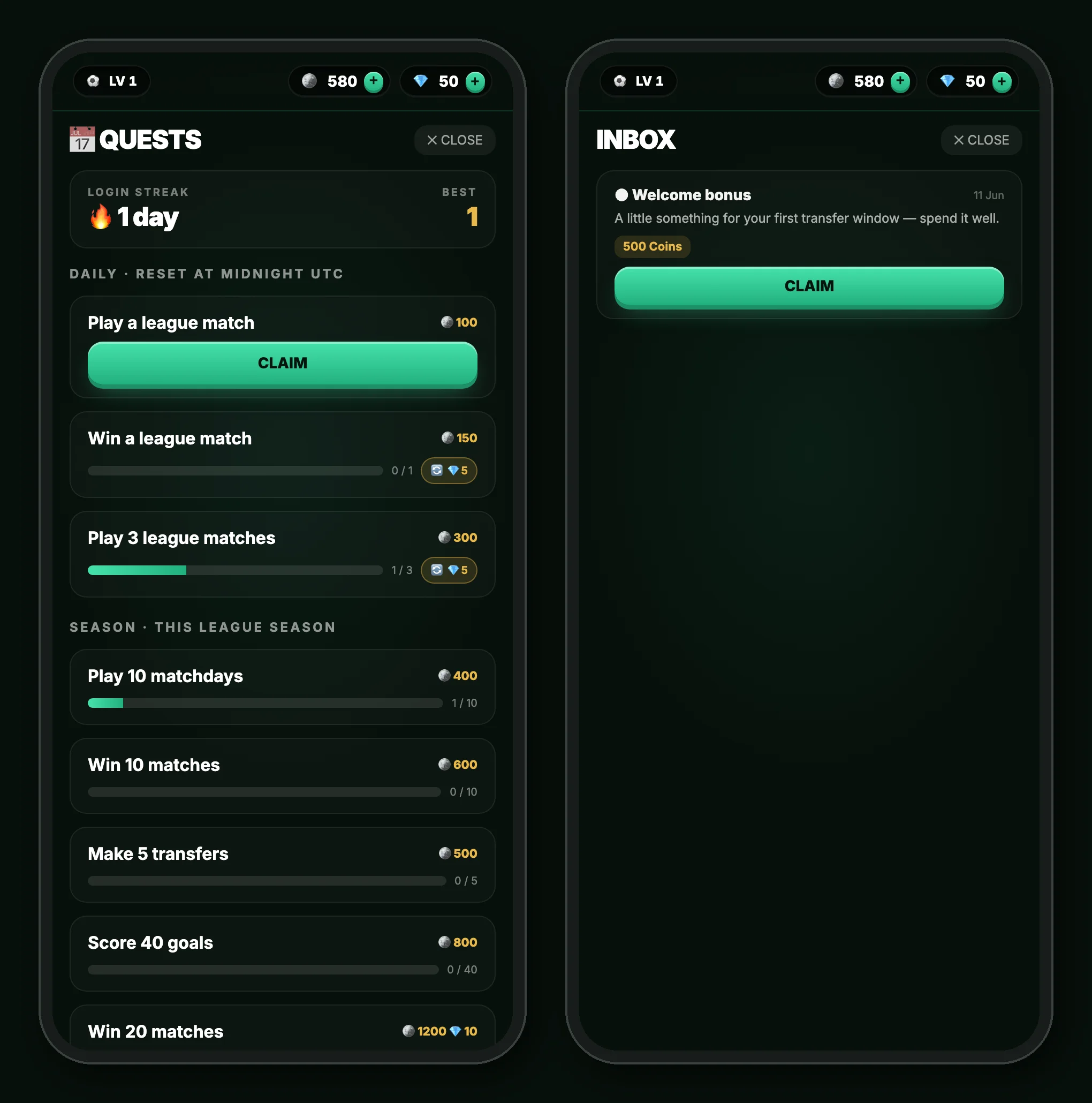
The World Cup commit added a whole layer to a game that was already live, without taking the season league apart:
- A World Cup mode with 48 real national squads, an R32-to-final bracket against CPU nations that get stronger each round, and a
WorldCupLeaderboardActorfor global rankings - Draft Cup, a pay-to-enter draft run against escalating opponents with prizes at the end
- A manager profile with honours, a trophy cabinet, all-time peaks and a player collection
- An objectives track with career rewards
- Value bundles, cosmetics, and Scout Packs that boost a draft before it starts
- Player-to-player trading of players and cash, held in escrow by the server until both sides clear
- Match reports written from each game's events in
MatchReport.cs, with no AI calls at runtime - 10 new test files, one for each new system
The new systems sit beside the old ones in the same PlayerModel. The 19 test files that were already there kept guarding the season league while the 10 new ones covered the additions.
How to run the FOOTDRAFT live service game sample
The project runs on Metaplay SDK Release 38, which is publicly available. Give this prompt to an AI coding agent such as Claude Code and it clones the repo, installs the Metaplay Agent and opens a local copy of the game in your browser:
Clone this repo and install Metaplay Agent using the Metaplay CLI, and open a playable version of the game locally in my browser so I can start building on top of it
3 months of Metaplay Starter, free for builders
Use code SHIP-FREE in the Metaplay Portal.
How to claim your discount
1Create a project
2Pick the Starter plan
3Add code at checkout
The code can be used once per customer.
FAQ
Can AI coding agents build and operate a live service game?
Yes. We built FOOTDRAFT, a multiplayer football manager with a live economy and LiveOps events, by prompting the Metaplay Agent for two days plus two overnight runs, then extended it with a World Cup mode in one further commit.
How long does it take to build a live service game with AI?
FOOTDRAFT's first public release took two days of prompting plus two overnight runs. The World Cup expansion followed thirteen days later.
What backend technology does FOOTDRAFT use?
The server is Metaplay SDK C# on Release 38, the client is a Blazor WebAssembly app in the browser, and the same PlayerModel and PlayerAction code runs on both. Game config compiles from a Google Sheet.
What does an AI coding agent need to work on a Metaplay game?
In FOOTDRAFT, a CLAUDE.md file describing the project and four Metaplay skills under .claude/skills/ covering development, DevOps, documentation and troubleshooting.
How do you build a turn-based multiplayer league game?
Keep the league on the server. In FOOTDRAFT a persisted LeagueActor holds each 20-team league, managers take turns drafting from a shared player pool, one matchday is simulated per day on the server so every manager sees the same result, and transfers between managers are settled by the server.