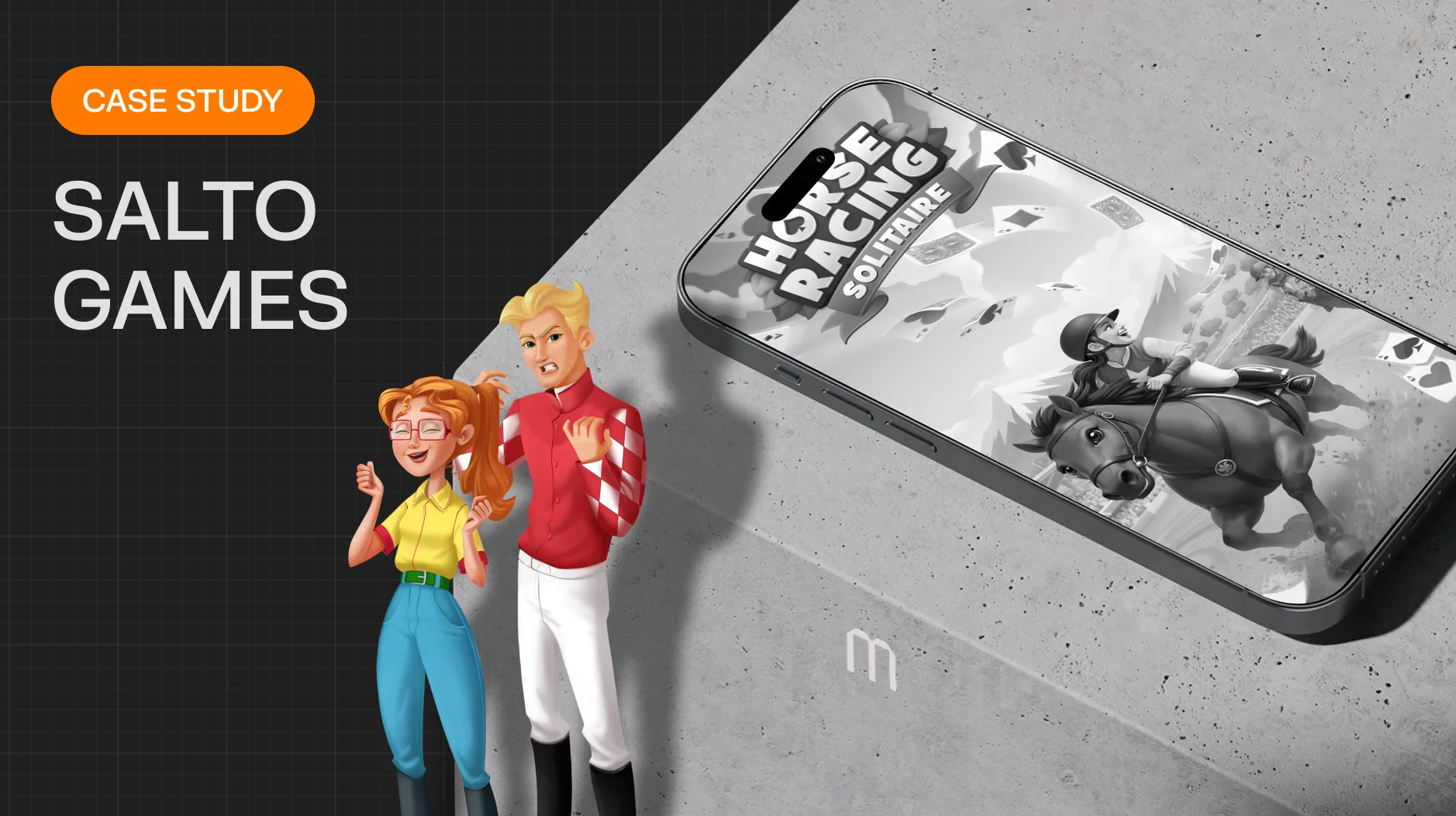

The founders of Salto Games have built globally successful mobile games before. When they started over, they chose Metaplay before writing a line of game code – and it shaped everything about how they work: how lean they stay, how fast they move, and how confidently they can scale.
When the founders of Salto Games had the chance to start something new, they already knew exactly what they wanted. They knew what a mobile game looks like when it really scales – and which decisions make that journey harder than it needs to be.
Salto was their chance to get it right from the start.

Game
Horse Racing Solitaire
Platform
iOS & Android (F2P)
Genre
Casual / Solitaire
Team size
3
HQ
London, UK
Founded
2024
Why experienced founders start with the backend
Brad Grievson (COO) and Corey Delprat (CEO) built F1 Clash at Hutch – a game that reached 25 million installs and $250 million+ in revenue. Matt Down (CTO) brings expertise from Gram Games and Space Ape Games, having helped build Merge Dragons (85 million+ installs and $1B+ in revenue) – he joined Brad and Corey freelancing before Salto came together. Between them, they'd built and operated games at real scale.
They'd also seen how the overhead grows with it. As games mature and teams expand, separate server and client engineers have to coordinate to ship a single feature. Technical debt accumulates. A/B testing – table stakes for any live game – gets deferred. "When games are older and you're running large server and client teams, there's a lot of complicated production involved," Brad says. "All this stuff just leads to quite slow development."
When Hutch was acquired and the team had the chance to start over, they knew exactly where to begin.
Why Salto Games chose Metaplay as their game backend
"One of the first things we started to do when we left Hutch," Brad explains, "was start thinking about what the design for this tech stack was going to be." That meant a serious evaluation of game backend platforms before a prototype existed.
Matt had already used Metaplay at a previous studio and knew the platform well. Brad had arrived at the same conclusion independently through his own research. Two things stood out.
The first was Metaplay's shared C# programming model – client and server logic written in the same language, with the server authoritative for all game state. A single engineer can own a feature end-to-end, without a separate server engineer alongside them. For a small studio trying to move fast, that matters enormously.
The second was the commercial terms. Metaplay provides source code access, and the contract is structured so that if Metaplay were ever to terminate, Salto could keep the SDK and continue operating independently.
We've seen games where a service gets pulled and you're suddenly in a crisis. With Metaplay, if it came to it, we could bring everything in-house and keep operating. That protection matters – investors see it the same way.

Brad Grievson
COO at Salto Games
What Metaplay makes possible for founders who've been here before

Matt sums it up directly: "We're punching well above our weight."
Building on Metaplay from day one meant the team had capabilities that studios often spend months or years building up to. They knew those capabilities would matter – that's why they chose the platform before writing a line of game code.
A few capabilities stand out – features that would each have taken significant engineering effort to build from scratch.
Schema migration and state management
Moving from a small validation build to hundreds of thousands of daily users is exactly the point where things go wrong without the right foundation. "Suddenly lots of players are going to be playing the game," Matt says. "But there's a level of reassurance. We plan for this." He's seen the alternative firsthand – a previous studio shipped an update that broke save files for a large number of players. "That was a real nightmare." With Metaplay handling schema migration and state management, that class of problem is largely removed.
A/B testing and live experimentation
The team ran an A/B test on their FTUE flow post-launch and got it up quickly through Metaplay. "Matt setting up that AB test – we were able to do that quite quickly," Brad says. Without the platform, building the testing infrastructure itself would have been a prerequisite before running a single experiment.
LiveOps dashboard and content management
The bigger live programming work – daily goal systems, tournaments – is next. "The fact that we can just hand over to someone to run the game is quite appealing," Matt says. As the team moves into more ambitious live events, the ability to manage content without engineering involvement matters more and more.
Running a live game without a large engineering team
Salto will hire more engineers as the game grows. But Metaplay has shifted the question from "how many people do we need to ship?" to "how many people do we need to build faster?"
"It obviously buys us a lot more time, rather than having a huge team with the burn rate super high," Matt says. "There's nothing in our roadmap that I can't implement myself – everything is going to be doable." Metaplay is what makes that possible for a single engineer.
Brad is direct about the alternative: "If you're starting a new company to build a game, you've just got to get to market as quickly as possible and validate the product. The alternative is hiring double the engineers – you need server engineers, you need to build a backend. The bigger the team, the slower you tend to go, the more you've got to maintain." Unspent burn rate is unspent runway.
From a growth perspective, there's nothing on the Metaplay side constraining them. "There's nothing that feels restrictive to growth coming from Metaplay," Brad says. "It's more that it'd be nice to have another engineer so we could build more features."
There's a longer-term benefit: as Metaplay becomes more widely used across the industry, engineers coming into the studio won't have to learn a proprietary in-house system from scratch. That's a friction that accumulates in studios that built their own tech – and one Salto won't face.
What it's like to work with Metaplay day-to-day
The platform had evolved since Matt first used it, but the documentation was thorough enough that he worked through the changes himself. "Everything I managed to figure out myself," he says. "It's different in some respects but actually a lot easier than it used to be."
Day-to-day, the team operates without a dedicated support arrangement. Occasional emails, the odd Discord message, the support portal when something specific comes up. They run independently.
The relationship beyond the product has been equally low-friction. "Everybody we have contact with is just very friendly and easy to deal with," Brad says. "It's quite a nice, seamless business relationship, and it does make a difference."
Build vs buy: what the Salto Games founders would tell you
Ask Brad and Matt what they'd tell another studio founder at the start, and they give the same answer.
Brad: "I would never start a game studio and build it all myself. It feels like a huge investment up front when you're not sure if the product you're trying to build is going to pay it back. All the time you're spending building tech is time away from the game itself."
If what you need to build has already been built, why duplicate the work? If you build your own version you'll find issues – it won't be battle-tested. With Metaplay, it is.

Matt Down
CTO at Salto Games
Matt: "You want to be focused. If you want to do something innovative and new, it should be the bit that other studios aren't doing. It shouldn't be reinventing the wheel every two days. Build what makes your game studio – not what everyone else is doing."
For Salto, that focus has meant a globally launched game, a lean team, and a LiveOps roadmap they're building into with confidence. The infrastructure question was answered at the start.
Want to see how Metaplay fits your stack? Talk to us or explore the docs.
FAQ
How did the founders of Salto Games build a globally launched mobile game with a small team?
They chose Metaplay before writing a line of game code – a deliberate decision from people who'd built games at scale before and knew which infrastructure choices compound over time. With schema migration, A/B testing, and LiveOps tooling in place from day one, a single engineer could own features end-to-end. Horse Racing Solitaire launched globally in February 2026 with a team of three.
What is Metaplay's shared programming model?
Metaplay uses a single C# codebase for both client and server logic, with the server authoritative for all game state. Game engineers can build features end-to-end without needing a separate server specialist for every feature. For small studios, this significantly reduces the engineering headcount required to ship and operate a live game.
Should a new game studio build or buy their backend?
Brad Grievson, COO of Salto Games: "I would never start a game studio and build it all myself. It feels like a huge investment up front when you're not sure if the product you're trying to build is going to pay it back. All the time you're spending building tech is time away from the game itself." For early-stage studios, building typically means hiring server engineers, constructing testing infrastructure, and maintaining custom systems – all before shipping a single feature.
What happens to our game if Metaplay discontinues their service?
Metaplay provides full source code access from day one, and the contract is structured so that if Metaplay were ever to terminate, studios keep the SDK and can continue operating independently. This was a key factor for Salto – and for their investors. "We could bring everything in-house and keep operating," says Brad Grievson. "That protection matters."
How does Metaplay handle scaling for small game studios?
Metaplay manages schema migration and player state automatically – the point where many games running on custom backends encounter serious problems. As player numbers grow after launch, updates that would otherwise risk breaking existing save files or player data are handled safely. For Salto Games, this meant being able to scale UA post-launch with confidence rather than anxiety about whether the infrastructure would hold up.
Is Metaplay suitable for a studio with no dedicated backend engineers?
Yes. Salto Games launched and scaled Horse Racing Solitaire globally with a team of three – with no dedicated backend or server engineers. Metaplay's managed cloud handles infrastructure and scaling, while the shared C# programming model means existing game engineers can handle server-side features without specialist knowledge.