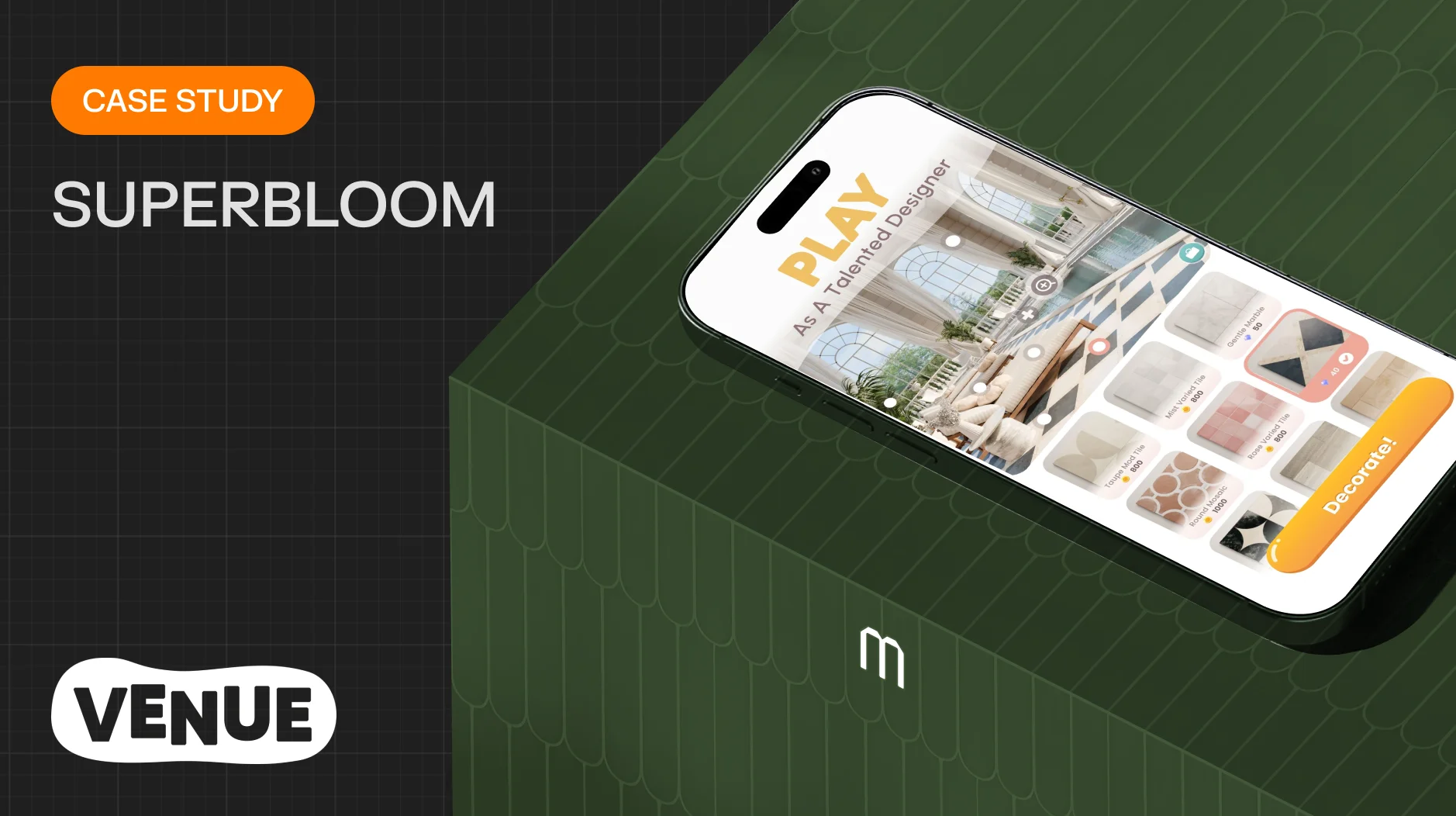

When people find out how lean Venue's engineering team is, they usually do a double-take. The game has 4,000 levels of content, live in-game events, and a Chainsmokers collaboration on the books. Co-founders Emily Yim and Ksusha Zito chose Metaplay before Venue had a single player – and that's what made the math work.
Emily and Ksusha had worked together at Dots before starting Superbloom in 2021. Emily came from product leadership roles at EA, Glu, and Drest. Ksusha came from an engineering background at New York Times Games. Between them, they'd seen enough of the industry to know two things: the lifestyle gaming category wasn't being taken seriously, and building backend infrastructure from scratch was a trap. They set out to make better games for women – and on the infrastructure question, they made a decision early and didn't revisit it. They chose Metaplay.

Game
Venue
Platform
iOS & Android (F2P)
Genre
Casual / Interior Design
Team size
20+
HQ
Remote (US & Europe)
Founded
2021
Venue: interior design as a live service game
Venue's premise is easy to grasp and genuinely satisfying to play. You're given a space – a rooftop, a beach house, a private jet – and a budget. You furnish it, arrange it, and submit it. Other players vote on your design. Your score determines your rewards and unlocks new content to work with.
The social layer is what makes it stick. Voting on other people's designs, seeing how they interpreted the same brief, the rhythm of submitting and waiting for results – it gives the game the kind of daily pull that lifestyle titles have always been good at. Venue executes it with more visual ambition than most of the genre.
Emily describes the core audience as adult women who want a hybrid experience: something grounded in real-life aesthetic sensibilities, with enough creative depth to feel genuinely satisfying. "We always wanted to make a casual version of this design category – somewhere you can customize any space you want, create something great visually, and actually train your home design instincts while playing."
Why Superbloom chose Metaplay as their game backend
When Superbloom started, the engineering side of the team had a specific profile. Ksusha and their first hire both came from strong Unity and C# backgrounds. They knew they wanted a setup where the same team could move comfortably across client and backend, without splitting the stack too early.
They looked at their options: hire dedicated backend engineers and build their own infrastructure, use an off-the-shelf solution and accept its limits, or find a platform that let their existing engineers cover both sides.
Metaplay's C# shared programming model settled it. Same language, same codebase, client and server logic side by side. "Our technical background is in Unity, on the client side," Ksusha explains. "The fact that Metaplay was C#-based was really helpful – it meant we could keep the team small and have the same engineers understand how the game worked on both sides."
They also evaluated other platforms covering similar ground. The alternatives ran backend services in Go and TypeScript – a language switch for a team whose entire codebase was Unity and C#, and one that would have taken real time to get comfortable with. The breadth of tooling for a content-heavy live game was another factor: the game config system built for thousands of entries, the event scheduling pipeline, the operator dashboard built around LiveOps workflows. Metaplay had more of that already in place. The way the conversation went also set a different tone from the start.
When we talked to other providers, it felt like we were being sold a service. With Metaplay, we felt like we were on a similar level and shared the same ambition. Even at the evaluation stage, that came through right away.

Ksusha Zito
CTO at Superbloom
The open architecture mattered for a separate reason. Metaplay's backend is source code you own and operate yourself – not a black box you attach to. "Even if we're not in the infrastructure every day, it matters that we can see how it works and own it when we need to," Ksusha says. "It's not a black box."
Onboarding Metaplay as a Unity team
The team's background was Unity and C# – client-side through and through. Picking up server-side patterns meant a real shift in thinking, but that was a deliberate trade-off for keeping one team across the whole stack.
"It takes a while to realize this works very differently," Ksusha says. "We definitely had to shift how we thought about things at first. We were used to a more traditional client-server setup, and Metaplay's model is different." Actor patterns, server-side state, the structure of a shared codebase – these were new.
What helped was how prescriptive the framework is. Metaplay gives you clear patterns to follow, and for the first several months, Superbloom didn't need to write custom services at all. They worked within the framework and got comfortable as they went. "Once we got used to the patterns, it started to feel pretty natural."
The team has stayed small and cross-functional – and after two and a half years with a live game, that model has continued to work. When something complex comes up, Metaplay's team fills the gap: reviewing work, answering architecture questions fast. That arrangement has held through launch, through scaling, and through everything since.
The Metaplay features Superbloom relies on
"From a LiveOps perspective, we use kind of everything," Ksusha says. Venue runs on Metaplay's game config system, LiveOps events, player profiles, A/B testing, player segmentation, in-app purchases, push notifications, and in-game messaging. A few of those features have become central to how the team operates day-to-day.
Game config management for content-heavy games
Venue is a content-heavy game. Close to 4,000 levels are configured in Metaplay's game config system – spaces, briefs, furniture items, progression gates, event parameters. Content managers, product managers, and engineers all work in it directly. That cross-functional access is a big part of how Superbloom operates without a large team: non-engineers can add and update content without filing tickets or waiting on a developer.
At the scale Venue has reached, Superbloom are pushing the config system further than most studios do. As the content library has grown, they've added more of their own checks and workflows around the config pipeline to keep everything manageable. It's a sign of how central the system has become.
| Space Name | Theme | Budget | Items | Difficulty | |
|---|---|---|---|---|---|
| 1 | Parisian Rooftop | Modern | $4,200 | 18 | Medium |
| 2 | Manhattan Loft | Industrial | $6,800 | 24 | Hard |
| 3 | Beach Bungalow | Coastal | $3,500 | 14 | Easy |
| 4 | Studio Apartment | Minimalist | $3,100 | 12 | Easy |
| 5 | Penthouse Suite | Luxury | $9,500 | 32 | Hard |
| 6 | Boho Greenhouse | Bohemian | $4,800 | 22 | Medium |
| 7 | Private Jet | Contemporary | $7,200 | 19 | Hard |
| 8 | Lakeside Cabin | Rustic | $2,900 | 15 | Easy |
| · · · | |||||
In-game events and celebrity brand collaborations
In-game events are a core part of how Venue keeps its player base engaged between content drops. Superbloom runs them regularly – themed design challenges with time-limited spaces, special briefs, and event-exclusive rewards.
The most notable to date was a collaboration with The Chainsmokers at launch. Players took on the duo as clients, designing their Hollywood mansion, Manhattan loft, and recording studio. The event ran for six days alongside the game's US launch in September 2024. The Chainsmokers are also investors in Superbloom through their venture firm Mantis.
Player segmentation, A/B testing, and LiveOps messaging
The player profile view in the LiveOps Dashboard is where customer support starts every investigation. Device migrations, currency grants, logs, custom actions – everything the support team needs is accessible from a single player view, without filing an engineering ticket or trawling through global logs to find what happened to one specific player.
Superbloom runs A/B tests and player segmentation on an ongoing basis. Targeting specific groups with different content, offers, or experiences is the kind of live game capability that takes real engineering effort to build from scratch – here it's built in.
Push notifications and in-game messaging cover the full player lifecycle – re-engagement, event announcements, targeted offers. The full messaging stack runs through Metaplay, with no separate third-party service required alongside it.
Game backend support that goes beyond a ticket queue
Superbloom's relationship with the Metaplay team is something they come back to consistently when they talk about what's worked. The Slack channel is fast enough that it functions less like a support queue and more like having a colleague nearby.
The fact that we can write in the Slack channel and anyone responds has been really great. We feel like we have a team next to us rather than one person stretched between multiple projects who can barely react.
Ksusha Zito
CTO at Superbloom
As Venue grew, there were a few moments where they hit limits they hadn't expected yet. In those cases, the Metaplay team helped diagnose what was going on quickly and get things stable before they turned into bigger problems.
Scaling a live service game through an industry downturn
When people find out how lean Superbloom's engineering team is, it tends to stop them.
Superbloom built and scaled Venue through one of the harder periods the games industry has seen – investment drying up, studios that had grown fast on post-COVID momentum cutting headcount, new games struggling to find their footing.
A lot of games like ours need much bigger teams just to keep the content and LiveOps machine running. Being able to avoid some of that overhead early on has been a big part of how we've stayed alive and kept moving.

Emily Yim
CEO at Superbloom
Ksusha frames it in terms of what the industry demands right now: "You need to get to validation and testing so quickly. You'll spend so much time just building infrastructure, focusing on the thing you might not even need if the game isn't actually good. Getting to the point where we could test was so important – and that was why we chose Metaplay."
Venue is now investing for the long term: deeper LiveOps, social systems, leagues and guilds on the roadmap. The team is also prototyping a second product. Two founders who set out to do things differently built a live game, outlasted an industry downturn, and are still running on three engineers. The backend choice they made in 2021 is still the same one.
Want to see how Metaplay fits your stack? Talk to us or explore the docs.
FAQ
How did Superbloom build a live service game with a small engineering team?
By choosing Metaplay at the very start. Metaplay's C#-based shared programming model meant the same engineers could work across client and server logic, keeping the team small and cross-functional by design. Player profiles, A/B testing, segmentation, game configs, IAP, and LiveOps tooling were all available from day one – nothing had to be built from scratch.
What kind of game is Venue?
Venue is an interior design and decoration game for iOS and Android. Players furnish and style spaces – rooms, venues, and themed environments – submit their designs for voting by other players, and earn scores that unlock new content. The game has been live for over a year and a half, with close to 4,000 design levels and regular in-game events.
Why did Superbloom choose Metaplay over other backend platforms?
Two things stood out. First, Metaplay's C# backend matched the team's existing Unity skill set – the same engineers could work across client and server without splitting the stack. Second, the relationship felt different immediately. "When we talked to other providers, it felt like we were being sold a service," CTO Ksusha Zito says. "With Metaplay, we felt like we were on a similar level and shared the same ambition."
What Metaplay features does Superbloom use for Venue?
Nearly the full live service suite: player profiles, A/B testing, segmentation, experimentation, in-app purchases, push notifications, and messaging. The game config system is where most of Venue's content lives – close to 4,000 levels, touched daily by content managers, product managers, and engineers. The player profile view in the LiveOps Dashboard is the first stop for any customer support investigation.
How does Metaplay's in-game event system work for a casual game like Venue?
Superbloom uses Metaplay's in-game event system to run regular themed design challenges – time-limited spaces, special briefs, and event-exclusive rewards. Events are scheduled and managed through the LiveOps Dashboard without requiring a code deploy. The most notable example was a launch collaboration with The Chainsmokers, where players designed the duo's Hollywood mansion, Manhattan loft, and recording studio over a six-day event. The entire event ran through Metaplay's existing LiveOps tooling with no custom infrastructure.
What would Superbloom tell a studio that's just starting out?
Ksusha Zito: "You need to get to validation and testing so quickly. You'll spend so much time just building infrastructure, focusing on the thing you might not even need if the game isn't actually good. Getting to the point where we could test was so important – and that's why we chose Metaplay."
Is Metaplay suitable for content-heavy casual games?
Yes. Superbloom's Venue runs close to 4,000 levels of content through Metaplay's game config system, managed daily by content managers, product managers, and engineers. Metaplay's LiveOps tooling – A/B testing, player segmentation, push notifications, and the LiveOps Dashboard – is used across the full lifecycle of the game. The platform isn't built exclusively for action or RPG games; any live service game with a strong content and LiveOps cadence can use it effectively.
How has Metaplay supported Superbloom through growth?
As Venue's player base grew, there were moments where they hit limits they hadn't expected yet. Each time, the Metaplay team identified and resolved the issue fast. Superbloom is on a dedicated support contract – day-to-day they operate through a shared Slack channel, questions get answered quickly, and the relationship functions less like vendor support and more like a technical partner on the same team.